
St. Mary's Island: The Geological Wonder of Columnar Basalt in the Arabian Sea
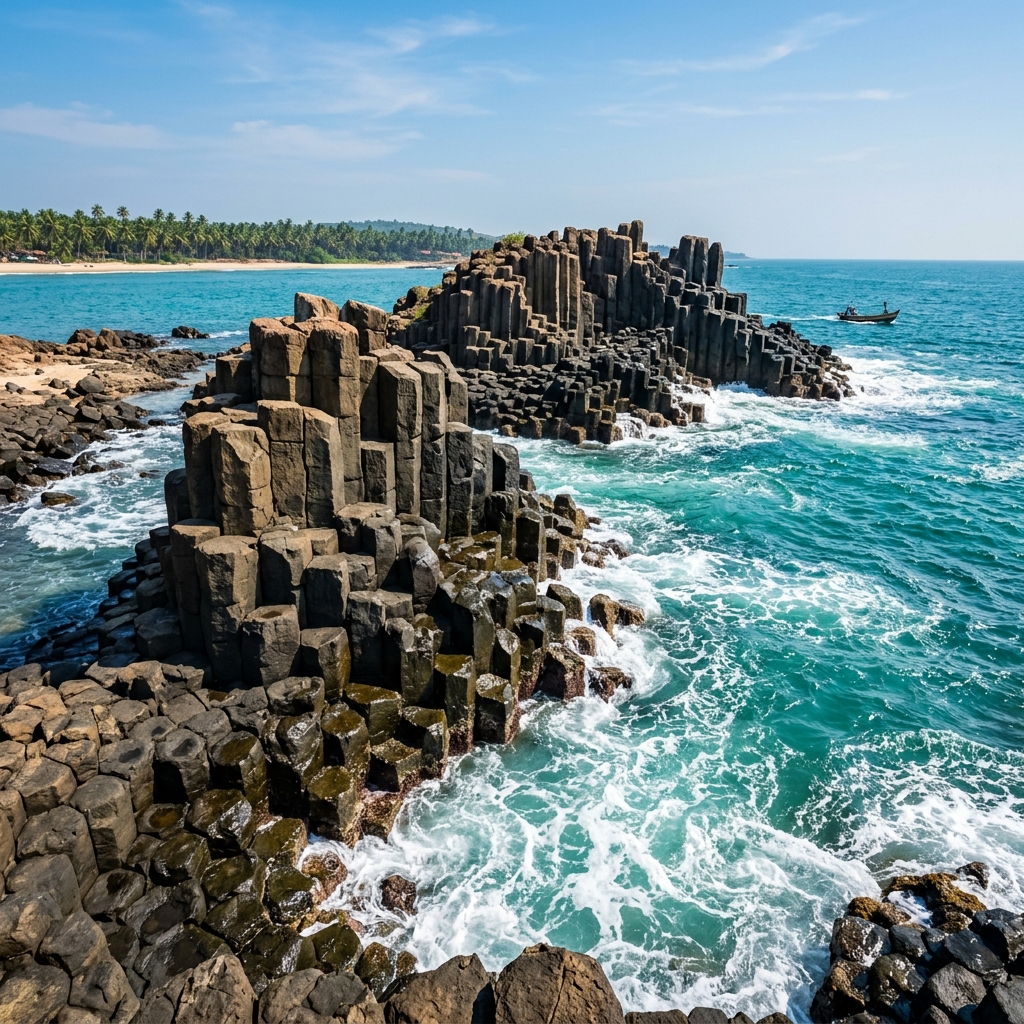
St. Mary's Island: The Geological Wonder of Columnar Basalt in the Arabian Sea
Just a brief 15-minute boat ride off the busy docks of Malpe Harbor in Udupi, Karnataka, lies one of India’s most extraordinary geological masterpieces: St. Mary's Island (also known as Coconut Island).
To the casual tourist, the island is a picturesque spot of pristine white sand and whispering coconut palms. But to geologists and oceanographers, it is a magnificent fossilized record of the earth’s violent tectonic past—featuring towering hexagonal columns of basalt rock rising directly out of the sapphire waters of the Arabian Sea.
🌋 The Science Behind the Columns: How Were They Formed?
The columnar basalt formations of St. Mary's Island are unique not only to India but to the entire world. They represent one of the only four geological monuments declared by the Geological Survey of India (GSI).
graph TD
    A[Supercontinent Gondwana] -->|Tectonic Rift| B(Madagascar splits from India - 88 Ma)
    B -->|Subaerial Volcanic Eruptions| C(Thick Basaltic Lava Floods)
    C -->|Uniform Cooling & Contraction| D[Hexagonal Column Jointing]
    D -->|Wave Erosion| E[St. Mary's Columns Today]
1. The Separation of Madagascar
Approximately 88 million years ago, the subcontinent of India was part of a different geographical configuration, sitting next to Madagascar. As tectonic forces ripped them apart, massive subaerial volcanic activity took place.
2. High-Magnesium Dacite Lava
The eruptions spewed a specific type of lava rich in silica and magnesium, known as dacite. As the thick lava sheets settled, they began to cool from the outside in.
3. Hexagonal Jointing
As volcanic materials cool, they contract. When lava cools uniformly on a flat surface, the contraction forces pull the material toward center nodes. This uniform contraction creates fracture lines at 120-degree angles, resulting in geometric, interlocking hexagonal columns.
🗺️ Ecological and Touristic Significance
The basalt columns stand tall, showing off shades of rust and charcoal against the blue waves. Because the island is protected as a national monument, no permanent human construction resides there, preserving a pristine marine habitat:
- Shorebird Sanctuary: The basalt rocks serve as crucial resting grounds for migratory birds, including sea eagles, terns, and sandpipers.
- Intertidal Tide Pools: The hollow recesses between columns compile small seawater pools, hosting anemones, tiny crabs, and unique varieties of green algae.
- Geological Tourism: Educational tours allow students and scientists to trace the exact fractures that tell the story of the birth of the Arabian Sea.
🛥️ How to Visit from Malpe Harbour
For visitors looking to explore this geological marvel, Seaveera provides up-to-date harbor schedules and vendor listings for the local boat transports:
- Ferry Operations: Regular boat services run from the Malpe Fishing Harbour and the Malpe beach daily, starting at 9:00 AM.
- Best Time to Visit: The clear post-monsoon months of October to May offer calm waters and optimal visibility.
- Eco-Rules: In order to save the delicate intertidal environment, single-use plastic is strictly banned on the island.
The next time you enjoy fresh mackerel or tiger prawns sourced from the Malpe auctions, take a glance outward at the horizon. The imposing basalt pillars of St. Mary's Island stand as a timeless, stone reminder of the deep, volatile history of the Arabian Sea.